

Note: This is NOT an inventory list. Please call to confirm availability.

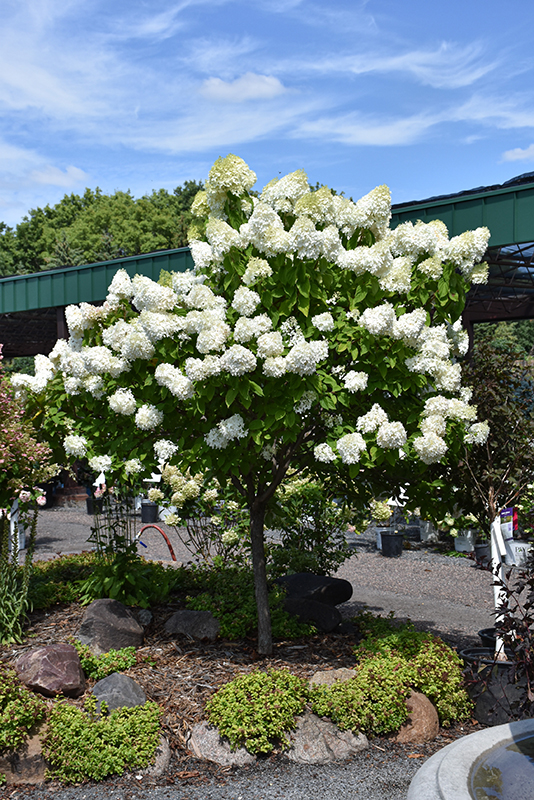
Vanilla Strawberry™ Hydrangea (tree form)
Hydrangea paniculata 'Renhy'

Height: 7 feet
Spread: 7 feet
Sunlight:


Hardiness Zone: 4a
Brand: First Editions
Description:
Wonderful white panicles turn raspberry pink over summer, then reddish pink in fall; a bold and audacious small tree that produces endless reams of massive and dense conical flower clusters at the ends of the branches; long-lasting blooms
Ornamental Features
Vanilla Strawberry™ Hydrangea (tree form) features bold conical white flowers at the ends of the branches from mid summer to late fall. The flowers are excellent for cutting. It has green deciduous foliage. The pointy leaves do not develop any appreciable fall colour.
Landscape Attributes
Vanilla Strawberry™ Hydrangea (tree form) is a deciduous dwarf tree, selected and trained to grow in a small tree-like form with the primary plant grafted high atop a standard. Its relatively coarse texture can be used to stand it apart from other landscape plants with finer foliage.
This dwarf tree will require occasional maintenance and upkeep, and is best pruned in late winter once the threat of extreme cold has passed. It has no significant negative characteristics.
Vanilla Strawberry™ Hydrangea (tree form) is ideal for use as a garden accent or patio feature, and is recommended for the following landscape applications;
- Accent
- Mass Planting
- General Garden Use
Planting & Growing
Vanilla Strawberry™ Hydrangea (tree form) will grow to be about 7 feet tall at maturity, with a spread of 7 feet. It tends to be a little leggy, with a typical clearance of 3 feet from the ground, and is suitable for planting under power lines. It grows at a medium rate, and under ideal conditions can be expected to live for 40 years or more.
This dwarf tree performs well in both full sun and full shade. It prefers to grow in average to moist conditions, and shouldn't be allowed to dry out. It is not particular as to soil type or pH. It is highly tolerant of urban pollution and will even thrive in inner city environments. Consider applying a thick mulch around the root zone in winter to protect it in exposed locations or colder microclimates. This is a selected variety of a species not originally from North America.


